

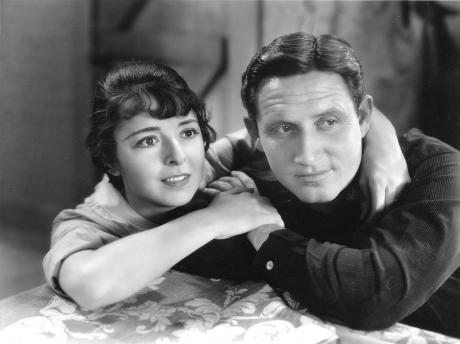
Fox, 1933. Director: William K. Howard. Screenplay: Preston Sturges. Camera: James Wong Howe. Film editor: Paul Weatherwax. Cast: Spencer Tracy, Colleen Moore, Ralph Morgan, Helen Vinson, Clifford Jones, Henry Kolker, Sarah Padden.
Some of our most precious vestiges of the classic-film era are the films that almost fell through the cracks—films that were threatened by the ravages of time, nitrate deterioration, or other hazards, but survived thanks to exhibition prints that were providentially preserved. In the case of the Fox studio, an entire chapter of film history was very nearly obliterated by a disastrous vault fire in 1937, a catastrophe that destroyed the primary materials of a multitude of Fox classics. For the survival of some of those films, we are more than usually dependent on such miraculously preserved release prints.
One notable survivor of that near-tragedy is The Power and the Glory, originally released by Fox in October 1933. We are indeed fortunate that a good print of this picture has now been restored and preserved by the UCLA archives, for it’s an unusually significant film, and a milestone in the career of Preston Sturges. Sturges, of course, needs no introduction to film enthusiasts. As the writer-director of The Lady Eve, Sullivan’s Travels, and other witty, high-energy comedy classics of the 1940s, he has earned an indelible place in film history. But it’s important to remember that he started as a writer and playwright, and cut his teeth during the 1930s as a studio screenwriter. In the midst of a run of contract assignments that included such varied and unlikely pictures as The Invisible Man and Imitation of Life, Sturges made his first major mark in the industry with an extraordinary original screenplay: The Power and the Glory.
In more recent years this film’s notoriety has been amplified by the recurring question: was it, or wasn’t it, an influence on Citizen Kane? It’s a natural question, for the similarities are unmistakable. A wealthy and powerful man dies, and his story is told in flashback by those who knew him—not in chronological order, but in jumbled sequence. It tells of a man both loved and hated, of a life marked by fabulous triumphs and crushing defeats, and ultimately brought low by personal tragedy. The latter-day viewer could scarcely watch this patchwork tale unfold without thinking of Citizen Kane. But the question of actual influence remains murky.
In any case, as always, the similarities serve to highlight the differences. And the differences are considerable. This film is definitely not another Citizen Kane, but, viewed on its own terms—the overriding theme of this column—it stands as a distinctive cinematic gem in its own right. Sturges introduces his protagonist by degrees, his character flaws balanced by virtues, revealed sometimes in surprising ways. Our view of him as a ruthless businessman, bending an entire board of directors to his will by sheer force, is later undercut by a touching scene from earlier in his life, in which his younger self bashfully admits to his lady love (a schoolteacher) that he has never learned to read, and submits to her for lessons. This fractured storytelling is not used simply as a gimmick; instead it heightens the emotional impact of the narrative. The ruins of a failed marriage become doubly heartrending when juxtaposed with scenes depicting the early years of the relationship, so filled with hope and joy.
Small wonder that producer Jesse Lasky called Sturges’ screenplay “the most perfect script I’d ever seen,” and undertook to produce it at Fox. It’s been reported that he ordered it filmed exactly as written, without changing a word, but in fact the finished film does depart from the written page in several respects.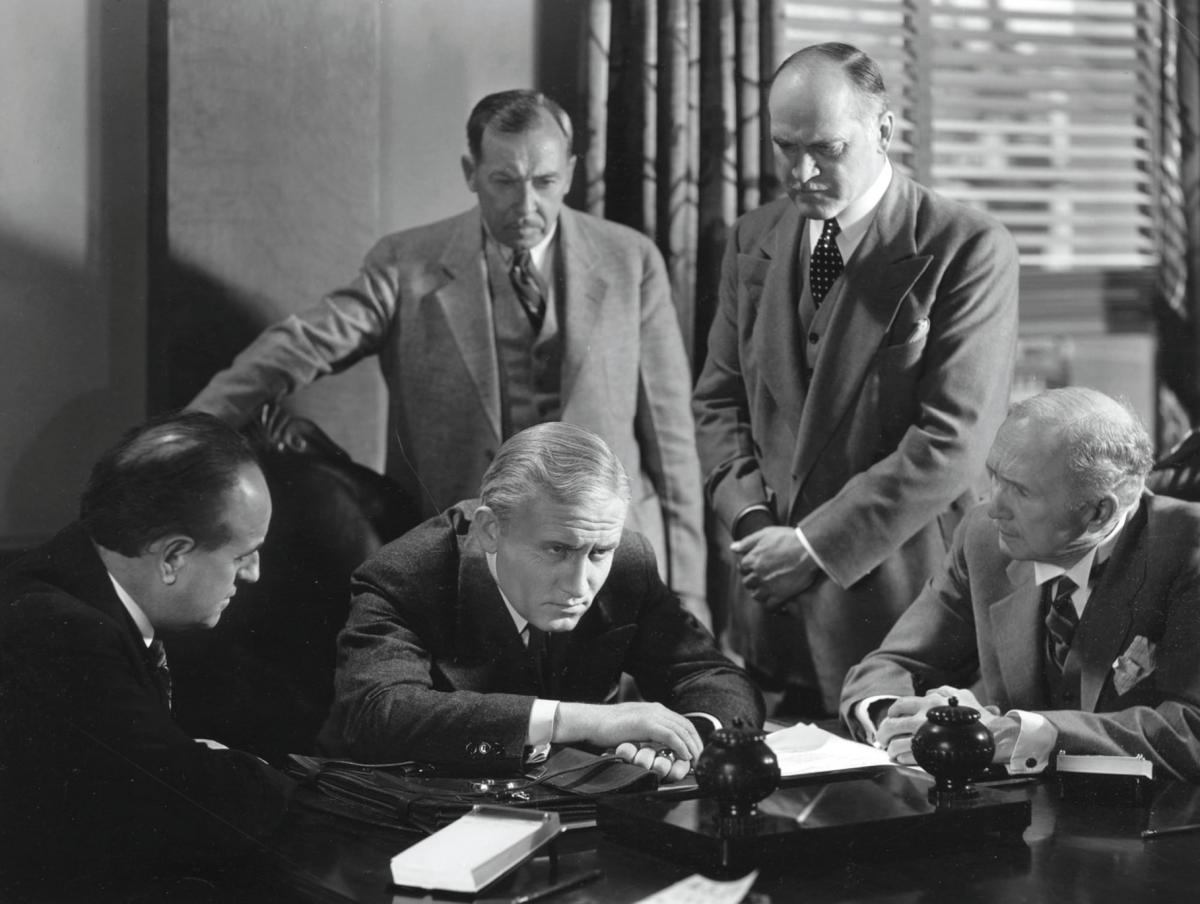 In particular, Sturges had written an ending that was dark and harrowing in the extreme. The film adopts a measure of restraint and makes the same story point with greater subtlety—probably wisely. Overall, however, Sturges’ artistic statement stands uncompromised in the final version.
And, of course, there are other notable talents at work here. The film’s director, William K. Howard, was a pictorial stylist who had learned his craft in the silent era, and ensured that Sturges’ tale was brought to the screen with masterful visual style. He was aided in no small measure by the great cameraman James Wong Howe, already well established in his own legendary career, who pictured the plot’s twists and turns with nuanced sensitivity.
The Power and the Glory gains much of its own power from a strong cast. Spencer Tracy is one of our most celebrated actors, but for some reason his consistently strong performances at Fox in the 1930s have always been underappreciated. This film offers him an excellent showcase: his patented intensity is on display in the more starkly dramatic scenes, but he’s fully up to the quiet underplaying required for the tender interludes. Colleen Moore had been typed, just a few years earlier, as the charming heroine of frothy Jazz Age comedies; here she tackles a far more challenging dramatic role and essays it with style. They are supported by Ralph Morgan as Tracy’s lifelong friend and confidant, Helen Vinson as a cunning adventuress, Clifford Jones as Tracy’s wastrel son, and a complement of Hollywood’s veteran character players in unbilled cameos: Robert Warwick, George Chandler, Russell Simpson, Mary Gordon, and more. With so many qualities setting it apart, we can be doubly thankful that this exceptional film has survived in any form—slightly marred by the occasional splice or jump cut, but essentially intact.
Special thanks to Margaret Kaufman, Mike Gebert, Dave Kehr, and Todd Wiener.
