

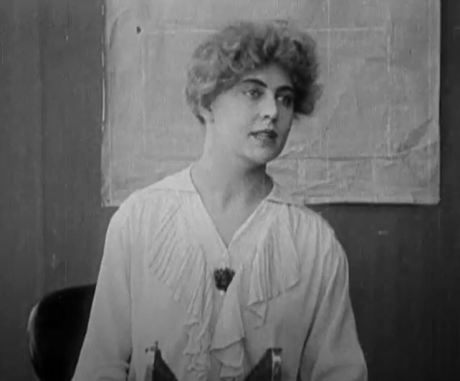
Universal, 1916. Directors: Lois Weber and Phillips Smalley. Scenario: Lois Weber and Phillips Smalley, based on the novel by James Oppenheim. Camera: Allen Siegler. Cast: Lois Weber, Phillips Smalley, Mary MacLaren, Edwin Hearn, Pauline Aster, Ben Wilson, Maude George, Neva Gerber, Charles Perley, Seymour Hastings, Countess Du Cello, Cecilia Matthews.
Some years ago, in this space, I wrote a column about the Lois Weber film Shoes (1916). Lois Weber is probably the best-remembered of all the women who directed films in the silent era, and the occasion for my column was the recovery and restoration of the previously “lost” Shoes, and its subsequent release on a Milestone Blu-Ray. That disc is still available (now through Milestone’s new distributor, Kino Lorber), and still highly recommended. But far too much of Weber’s body of work remains frustratingly out of reach. Especially tantalizing are the films that have partially survived, known to exist only as fragments.
One particularly fascinating fragment is a film that was released just three months after Shoes. That film is Idle Wives, based on a novel of the same name by James Oppenheim, who was a well-known author and, like Lois Weber, a fierce devotee of the Progressive movement. A former settlement worker, Oppenheim had written several social-consciousness films—among them The Fight for Right (about prison reform) and The Crime of Carelessness (based on the Triangle Shirtwaist Fire)—before he published Idle Wives in 1914. His novel, tackling a range of issues in a single work, was ideal subject matter for Weber, who never shied away from social crusading in her own films. She once told an interviewer that her goal was to be “the editorial page of the Universal Company.” In her hands, Oppenheim’s novel became a seven-reel feature. Today we can glimpse it by way of the first two reels, which were rediscovered separately and later combined and preserved together. And even in that fragmentary form, Idle Wives holds a wealth of fascination for the film enthusiast.
In the opening scenes, we see an assortment of ordinary people attempting to deal with the problems in their lives. A married couple, having grown apart, contemplate separation. A poverty-stricken family quarrel and clash with one another under the endless stress of their privations. Across the hall, in the same tenement building, a young girl rebels against parental control and threatens to run away with a young man, a small-time tough who devotes himself to terrorizing the community.
What unites this disparate group of people? Answer: fate brings them all to the neighborhood movie house on the same evening. Advertising outside the theater announces the movie they have come to see: “Life’s Mirror, by Lois Weber.” And one by one, as they settle into their seats, they begin to recognize their own stories reflected on the screen—life’s mirror indeed.
This idea, an individual confronted by truths about himself and his life in the form of popular entertainment, was not a new device in 1916. D.W. Griffith had done something similar in A Drunkard’s Reformation (1909), in which the drunkard of the title witnessed a theatrical performance of a temperance play and, shamed by example, resolved to change his ways. Griffith had continued to use similar devices in some of his later Biograph films, and other early filmmakers had followed suit. The difference in Weber’s film is its feature length: with so much footage to work with, she can explore the theme with greater variety and greater nuance.
One of the hallmarks of Weber’s career is her insistence on her role as “the editorial page,” the purveyor of important social truths. Her films exhibit professional cinematic style and good acting performances, but always, only, in support of her theme or message; style is always secondary to substance. She frequently breaks the fourth wall with straightforward, conversational intertitles, speaking directly to the viewer. 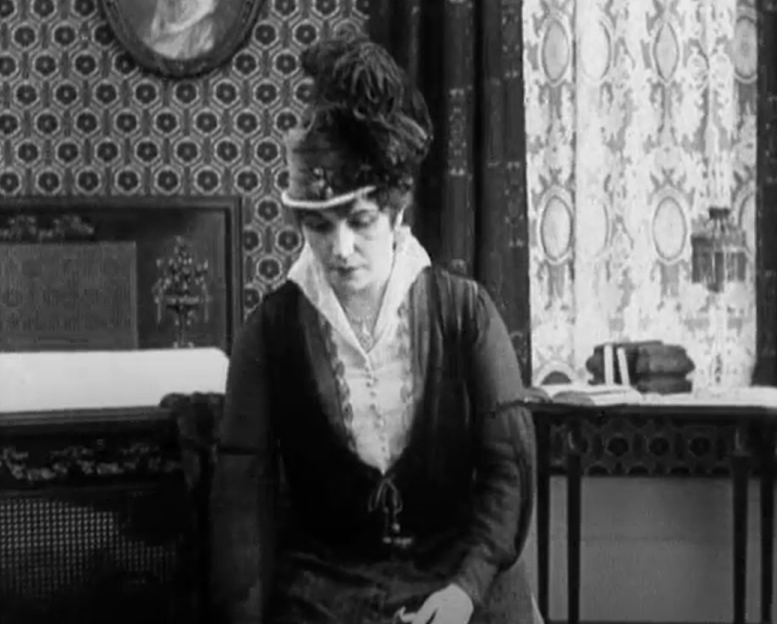 Her drive to break down the walls of artifice and engage the viewer on a personal level is especially evident in Idle Wives, with its intermingled layers of fact and fiction. The intertitles are characteristically direct (“Mary Wells represents you girls who rebel against home restraint,” one title helpfully informs us). Weber herself is not only identified in the story as the director of the film-within-the-film, but appears onscreen as one of the characters in that film. This in itself was not unusual; Weber was occasionally seen enacting roles in her own films. But truth and fiction are unusually blended here, as Weber and her real-life husband, Phillips Smalley, are seen portraying the estranged couple onscreen in Life’s Mirror. The two had worked for years as a writing-directing team and had been jointly credited in their films, but by 1916 Weber was increasingly recognized as the dominant talent in the family. Soon the two would part ways and would continue with separate filmmaking careers throughout the 1920s.
All this in the first two reels! So what are we missing from the remainder of the feature? To begin with, the balance of Lois Weber’s own acting performance. We do see her in a long introductory scene in the second reel, but the rest of her performance is missing, and we never see Smalley at all. Neither do we get any glimpse of Mary MacLaren, the star of Shoes, who had followed the success of that film by remaining in Weber’s stock company and played featured roles in four more of her films, including this one. And, of course, we’re deprived of the full arc of the story, in which the “real” characters absorb the examples of their screen counterparts and, hopefully—at least some of them—profit by that lesson in their own lives.
But our cup is more than half full. Eventual recovery of the still-missing five reels, if it ever happens, will be a happy event and cause for celebration. In the meantime, however, this fragment of Idle Wives is a jewel in its own right. Our friends at the National Film Preservation Foundation have made it available online, without music, in the “Screening Room” section of their website. The enterprising enthusiast can also find it in Kino Lorber’s First Women Filmmakers collection, enhanced with an evocative piano score by Eunice Martins. Either way, it’s recommended as an intriguing glimpse of history, and as one more step in reconstructing the oeuvre of one of our most important and distinctive filmmakers.
